Return to Transnistria

Our journey to Ukraine and Moldova goes on. The wish of my friend Sylvia to visit Bessarabia gave me a good pretext to return to Chişinău (Kishinev). While our friends Marla and Jay returned to Lviv yesterday, Sylvia and I took the bus to the Moldovan capital. Today we were out for a long day trip to Transnistria, a break-away ‘state’, only aknowledged by Russia. We visited Dubăsari (Dubasari), Raşcov (Rashkov) and Rîbniţa (Rybnitsa).

Continue reading

Kosiv today

The volunteers of SVIT Ukraine, who clear the Jewish cemetery in Chernivtsi (Czernowitz), were out for a day trip today. On the itinerary was among others the Galician town of Kosiv – famous for its local crafts market – and its Jewish cemetery. In the densely overgrown cemetery we met an old man who was mowing grass with a scythe. He had a story to tell.

Continue reading

Of traveling in Moldova, Jewish cemeteries, vanished worlds and photographs

Usually Christian is the author if this blog. Recently he gave me the opportunity to write about my impressions of the journey we just had together in Moldova. I am thankful to have a place to publish my thoughts.

Continue reading

Exhibition on the Holocaust in the Galician Oil Belt opened in Cologne

On 18 February ‘A Story of Destruction and Rescue’, an exhibition documenting the Holocaust in the eastern Galician towns of  Drohobych and Boryslav was opened in Cologne. The exhibition was created by an international team from Poland, Israel, Ukraine and Germany. It was already on display in several locations in Poland and Ukraine and will be shown in more places in Israel and Ukraine this summer. The Cologne exhibition will remain open to the public until 31 March.

Continue reading

Three days in Riga

Latvia’s capital Riga looks back on a rich Jewish heritage from the middle ages up to the present. Riga ghetto was the last destination for many Latvian Jews as well as for those who were deported from the Reich. Today there are remembrance sites as well as a functioning Jewish community. A long weekend gave me the opportunity to have a look on it.

Continue reading

In Transnistria

Transnistria was a Romanian deportation zone for Jews and Gypsies during the war. Thousands died of typhus, inhuman working conditions, of hunger or were shot. My fellow traveler Sylvia was here more than 70 years ago when she was a little girl. Today we explored some places in Transnistria – now part of Podolia in Ukraine.


Continue reading

Plans For June

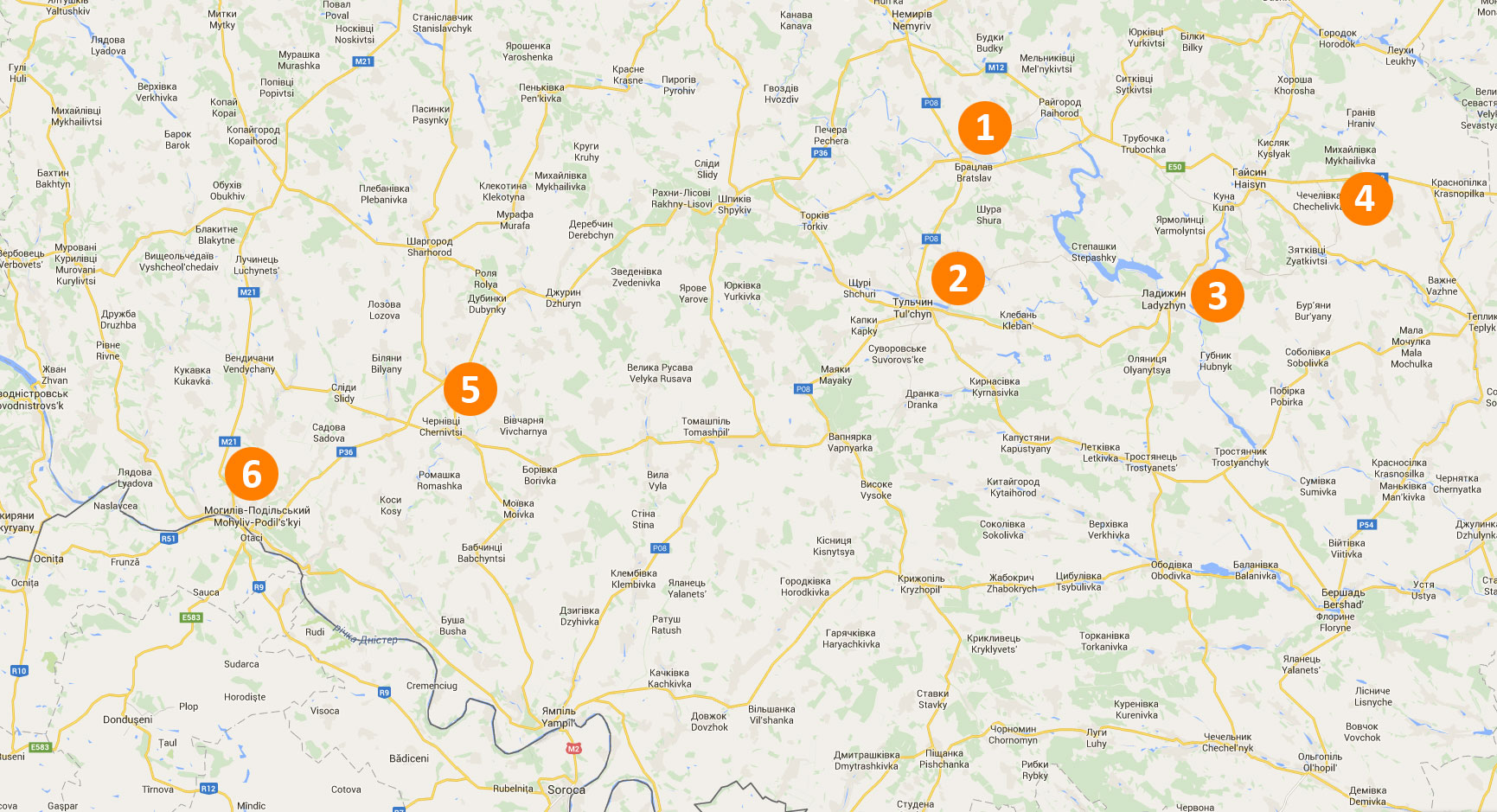
From June 5 to 15 I will travel in Ukraine again. Together with my friend Sylvia de Swaan I will thereby explore an area that is unknown to most people. However, those who have heard of Transnistria, think of the place with horror.

Travel locations in Transnistria

Travel locations in Transnistria

1. Bratslav, 2. Tulchyn, 3. Cariera de Piatra, 4. Mykhailivka, 5. Chernivtsi, 6. Mohyliv-Podilskyi

Continue reading

A last excursion to Galicia

Again, I was travelling with Vasyl and Renata. I highly appreciate both of them – because of their kindness and because of their excellent knowledge of local history. My journey is slowly coming to an end and it was a final opportunity to explore Galicia during this trip. Olesko and Busk were the places we went to.

Continue reading

Into The Nothing

Trochenbrod (Trachimbrod, Sofiyovka) was an all-Jewish town that was completely wiped out. Not a single stone has been preserved from a place with formerly 6,000 residents. Nevertheless Trochenbrod has a unique afterlife – the place became famous through Jonathan Safran Foer’s novel “Everything Is Illuminated” and the film adaptation by the same title. Like many others, I thought Trochenbrod was fiction. But Trochenbrod existed.

Continue reading

In The Mist

Podgorze is the other Krakow. West of Vistula river – opposite the old town – there are no magnificent old buildings, no picturesque places and no cozy cafes for locals and tourists. Severity hangs over the houses from the 19th century and the interwar period. Many facades are blackened by the smoke of industry, some house are empty – the windows boarded up. Podgorze is the district in which the Nazis established a ghetto – for its Jewish inhabitants it was the beginning of the end. Further west is Plaszow, the territory of a former concentration camp.

Continue reading