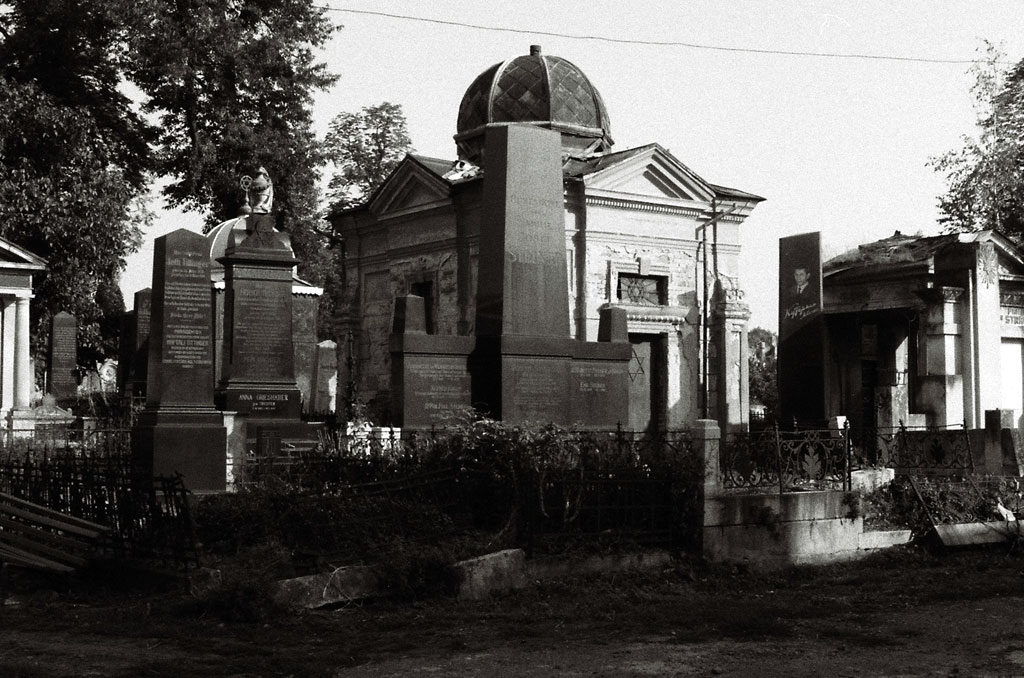
May 1. Kolomiya turns out to be a pretty and lively town. We decide to stay a day longer than we originally planned, and to take a trip from here to southern Galicia. Yabloniv, Kosiv and Kuty are our destinations.
Continue reading
May 1. Kolomiya turns out to be a pretty and lively town. We decide to stay a day longer than we originally planned, and to take a trip from here to southern Galicia. Yabloniv, Kosiv and Kuty are our destinations.
April 30. Our time in Chernivtsi (Czernowitz) comes to an end. We have to say Goodbye to the city and to dear friends. The second part of our journey begins. On the way back through Galicia are Zabolotiv (Zablotow) and Kolomiya our first stops.
April 29. My fellow travelers and I have time to stroll through the streets of Chernivtsi (Czernowitz). As always, it is wonderful to be here. In October last year I wrote about the lost synagogues of the city. Berti Glaubach then made me aware of an error. Now I have a chance to correct my mistake.
April 28. We drive through Bukovina: Storozhynets, Davidivka, Vyzhnytsia and Vashkivtsi. We are in search of the traces of a Bukovinian celebrity – Joseph Schmidt. And of course, there is a lot along the way to see.
April 26. Chortkiv is our last stop in Galicia, a former center of Hasidism. Then we travel further south, into the Bukovina and towards Chernivtsi (former Czernowitz).
April 25. We travel further through Eastern Galicia. Berezhani, Pidhaitsi, Buchach, Chortkiv – remains of synagogues, cemeteries and rabbinical courts.
April 24. Zigzag through Galicia: From Brody via Zolochiv, Pidhirzhi and Rohatyn to Berezhani. On the way are spectacular monuments – but also very sad places.
Our first day of travel on the roads of Galicia. We want to start things slowly. From Lviv to Brody is 80 kilometers. In between, we will make a stop in Busk. In both places we are mainly interested in the Jewish cemeteries.
Next to the village of Lysynychi – now a suburb of Lviv (Lwow, Lemberg) – tens of thousands of people were murdered by the SS and their helpers. No one knows how many. The numbers vary between 50,000 and 200,000. The victims were mainly Jews, but also members of the Polish resistance, Russian prisoners of war and thousands of Italian soldiers who were massacred by the Germans after the capitulation of Italy. Does something commemorate these crimes and their victims in the forest of Lysynychi? Today I was there.
This is a poem by Tom Berman, the great-grandson of Lazar Igel, the first Rabbi of the Czernowitz Temple. Tom died a few days ago in the Galapagos islands; it was a life-long dream of him to go there. Tom survived Nazi dictatorship over huge parts of Europe through the “Kindertransport” to England. His family was erased. The poem reflects this. Tom immigrated to Israel and became an internationaly known scientist. He survived the time of persecution by 68 years.